Guarding the Atlantic: African Warships Take Center Stage in Historic New York International Naval Review

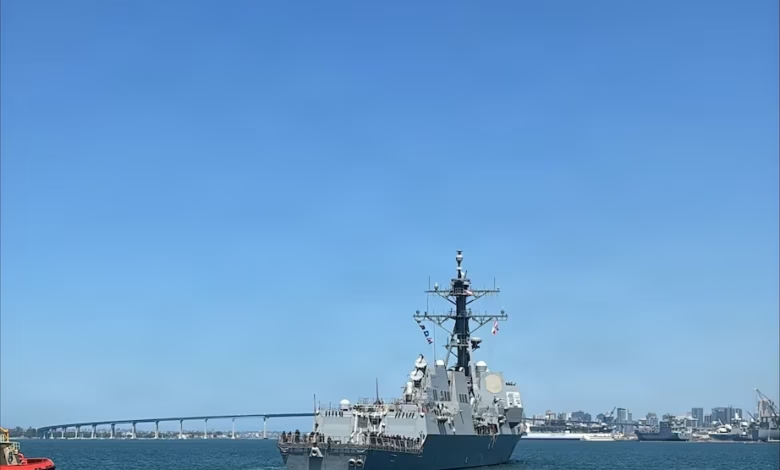
The Port of New York and New Jersey transformed into a sprawling theater of global maritime cooperation as the United States launched the International Naval Review 250, marking the nation’s semiquincentennial anniversary with the largest naval gathering in decades.
Amid a formidable armada of over one hundred vessels, thirty tall ships, and approximately sixteen thousand service members hailing from across the globe, two African warships emerged as prominent anchors of the multinational event.
The Royal Moroccan Navy’s flagship frigate, RMNS Mohammed VI, and the Senegalese Navy’s advanced offshore patrol vessel, Niani, successfully completed a demanding transatlantic crossing to represent the African continent on one of the world’s most prestigious maritime stages.
The high-profile deployment underscores the rapidly advancing operational endurance, strategic readiness, and logistical capabilities of African maritime forces, signaling their growing role in securing the critical sea lines of communication that bind Africa, Europe, and the Americas.
The presence of the African vessels in New York Harbor serves as a powerful testament to the deepening security architectures and bilateral trust cultivated through years of joint exercises, professional exchanges, and tactical cooperation at sea.
Admiral George Wikoff, commander of U.S. Naval Forces Africa, emphasized that the active participation of these regional partners reflects enduring relationships designed to bolster interoperability before complex maritime crises materialize.
While Morocco and Senegal commanded the waterfront with their physical assets, the geopolitical footprint of the continent was further expanded by senior naval and government delegations from Ghana, Côte d’Ivoire, Cameroon, Equatorial Guinea, and Kenya.
These delegations engaged in high-level strategic dialogues focused on maritime domain awareness, coordinated information sharing, and collective regional responses to pressing transnational threats, including piracy, illegal trafficking, and illicit fishing in the Atlantic basin.
Representing North Africa, the RMNS Mohammed VI stands as one of the largest and most sophisticated surface combatants currently in service with any African navy, The 142-meter, 6,000-tonne Franco-Italian multipurpose FREMM-class frigate, commissioned in 2014, mirrors the deep historical baseline of U.S.-Moroccan relations, which boasts the longest unbroken treaty relationship in American history dating back to the 1786 Treaty of Peace and Friendship.
Designed for high-intensity multi-mission operations, the frigate features a robust armament configuration engineered to project substantial defensive and offensive capabilities.
Its arsenal includes a rapid-fire Oto Melara three-inch main gun capable of discharging 120 rounds per minute, sixteen MBDA Aster 15 vertical-launch surface-to-air missiles for comprehensive air defense, Exocet MM40 Block 3 anti-ship missiles for surface warfare, and six specialized torpedo tubes for anti-submarine engagements.
The successful long-range deployment of this heavily armed platform highlights the meticulous logistical planning, continuous engineering maintenance, and sophisticated command-and-control frameworks sustained by the Royal Moroccan Navy.
Sailing alongside global powers from West Africa, Senegal’s Niani demonstrated the tactical agility and expanding horizons of the continent’s modern offshore patrol fleets. Built by the French shipyard Piriou as the second of three Walo-class patrol vessels, the Niani measures 62.2 meters in length, displaces roughly 600 tons, and possesses an impressive operational range of 4,500 nautical miles at a cruising speed of 12 knots.
While primarily tasked with local sovereignty patrols, fisheries protection, and maritime surveillance within Senegal’s exclusive economic zone, the vessel features an unusually heavy weapon layout for its displacement, making it uniquely suited for international operations.
The Niani is equipped with four MBDA Marte Mk 2N anti-ship missiles and a SIMBAD-RC air defense system armed with Mistral 3 surface-to-air missiles, complemented by a 76 mm main gun and multiple rapid-fire cannons. Prior to dropping anchor in New York, the Niani honed its tactical readiness by participating in Fleet Exercise 250 alongside eighteen partner navies in Norfolk, Virginia, proving its ability to integrate seamlessly into complex coalition structures.
As the historic Parade of Sail concluded and the week-long program of professional symposiums, public ship tours, and tactical demonstrations got underway, the successful arrival of these African crews sent a clear signal to the international community.
No single navy can safeguard the vast expanses of the global maritime commons alone, and the technical competence displayed by the Moroccan and Senegalese crews proves that African nations are no longer merely consumers of regional security, but active contributors to international oceanic stability.
By projecting power across the Atlantic and standing shoulder-to-shoulder with the world’s most advanced naval forces, the deployment marks a historic milestone that will likely redefine the parameters of future maritime security agreements and coalition operations throughout Africa’s strategic waters.
read more
The Bibliotheca Alexandrina: A Great Cultural Beacon, Past and Present