African Trade Report 2026: Africa’s GDP Growth Reaches 4.5%, Intra-African Trade Hits $213.8 Billion Amid Global Geopolitical Shifts

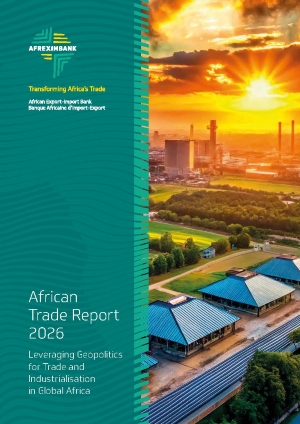
Afreximbank Report Highlights Africa’s Rising Economic Resilience and Expanding Trade Opportunities
Africa’s economy demonstrated remarkable resilience in 2025, with real GDP growth accelerating from 3.4 percent in 2024 to 4.5 percent, significantly outpacing global growth trends, according to the newly launched African Trade Report 2026 by the African Export-Import Bank (Afreximbank).
The report also revealed that inflation across the continent declined sharply from 21.6 percent to 13.1 percent, while Africa’s merchandise trade expanded by 6.1 percent to approximately US$1.5 trillion.
Intra-African trade also recorded strong growth, increasing by 5.5 percent to reach US$213.8 billion.
These figures underscore the continent’s growing economic strength, enhanced macroeconomic management, and increasing capacity to navigate a rapidly evolving global environment.
Published under the theme, “Leveraging Geopolitics for Trade and Industrialisation in Global Africa,” the African Trade Report 2026 arrives at a critical juncture for both Africa and the global economy. The report examines how shifting geopolitical dynamics, evolving global supply chains, technological transformation, and changing trade and investment patterns are reshaping the international economic landscape.
According to Afreximbank, these global developments present Africa not only with significant challenges but also with an unprecedented opportunity to reposition itself as a dynamic hub for production, trade, innovation, and sustainable economic growth.
Africa’s Economic Performance Reflects Growing Resilience
The report highlights the increasing resilience and potential of African economies despite a complex and uncertain global environment. Africa’s stronger economic performance was supported by improving macroeconomic management, stronger institutions, enhanced regional cooperation, growing cross-border investment flows, and the determination of African countries to sustain economic growth.
The significant decline in inflation across the continent reflects improved economic stability, with some African countries recording inflation rates as low as 3 percent. Meanwhile, continued growth in merchandise trade and intra-African commerce demonstrates the expanding integration of African markets and the increasing effectiveness of regional economic initiatives.
These positive outcomes reaffirm Africa’s ability to adapt to external shocks while maintaining a steady trajectory toward long-term economic transformation and industrial development.
Geopolitical Tensions Reshape Global Trade Landscape
The report notes that the global trade environment has become increasingly complex due to a combination of geopolitical tensions, geoeconomic fragmentation, and broader structural changes. Together, these factors have created a more uncertain and risk-prone international trading system.
Global trade flows have been affected through disruptions to supply chains, rising trade costs, and increased market instability. At the same time, technological advancements—particularly in artificial intelligence (AI)—have emerged as powerful drivers of change, transforming trade logistics, customs administration, and the structure of global value chains.
As countries and corporations reassess supply chain strategies, new opportunities are emerging for regions capable of providing stable and resilient production platforms.
Persistent Challenges Continue to Affect African Trade
Despite the encouraging economic progress recorded across the continent, the report acknowledges that several structural challenges continue to constrain Africa’s trade and industrialisation ambitions.
Among the most pressing issues are limited access to trade finance, significant infrastructure deficits, and insufficient value addition across multiple sectors. These constraints continue to hinder competitiveness and limit the continent’s ability to fully capitalize on international market opportunities.
However, the report emphasizes that these challenges also highlight the immense opportunities available to Africa. As global supply chains diversify and businesses seek alternative production destinations, the continent is increasingly positioned to attract investment in manufacturing, digital innovation, green industrialisation, and export-oriented industries.
Afreximbank Calls for Urgent Action to Convert Global Fragmentation into Growth
A central message of the African Trade Report 2026 is that Africa must act decisively to transform global fragmentation into a catalyst for resilient, inclusive, and value-added economic growth.
To achieve this objective, the report outlines several strategic priorities.
First, African development finance institutions should be strengthened through increased capitalization and more equitable global regulatory frameworks.
Second, the implementation of the African Continental Free Trade Area (AfCFTA) must be accelerated, particularly regarding tariff schedules, rules of origin, and effective national coordination mechanisms.
Third, African countries should expand digital payment infrastructure to reduce currency-related barriers and logistical bottlenecks that continue to affect trade efficiency.
Finally, the continent should intensify advocacy efforts for reforms to the global financial system, including improvements to international rule-making processes and debt restructuring mechanisms.
Strengthening Industrialisation and Intra-African Trade
As geopolitical developments continue to reshape global trade patterns and supply chains, Africa’s ability to benefit from these transformations will depend on its capacity to strengthen industrial ecosystems, deepen regional trade integration, and sustain coordinated financial support.
The report stresses that adaptive policy frameworks, strategic trade positioning, and robust foreign direct investment interventions will play a critical role in building a resilient, inclusive, and sustainable industrialisation pathway for Global Africa.
To fully unlock these opportunities, African governments and institutions must accelerate the implementation of the African Continental Free Trade Area (AfCFTA), expand access to intra-African trade finance, improve transport and logistics infrastructure, and deepen digital payment systems through the Pan-African Payment and Settlement System (PAPSS).
According to the report, the continent’s future competitiveness will depend on how effectively it leverages current geopolitical shifts to drive industrial development, increase value-added exports, and strengthen Africa’s position within the global economy. The imperative for action is immediate, and the opportunity for transformation has never been greater.
read more