Egypt Warns Against Unilateral GERD Operation, Reaffirms Rights Under International Law

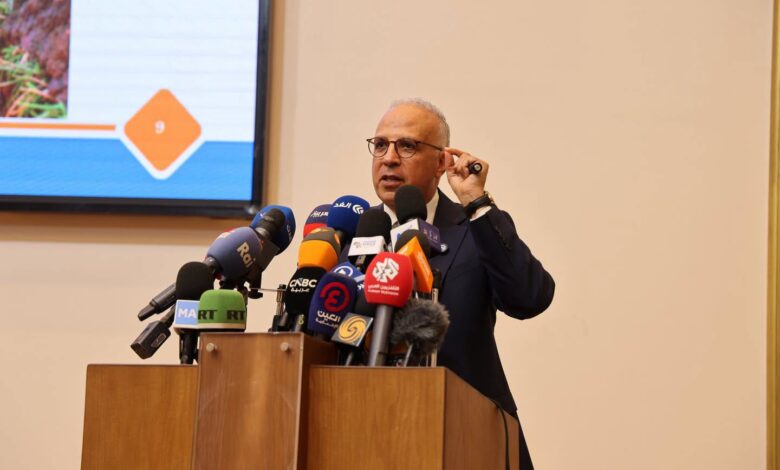
Sewilam: Egypt Will Not Accept Unilateral Control of Nile Flows or a New Fait Accompli in the Eastern Nile
Egypt will not ignore what it considers its vital interests in the Nile and will not accept attempts to control or dominate water flows to downstream countries, Minister of Water Resources and Irrigation Prof. Hani Sewilam said, reaffirming that Egypt retains all measures and procedures available to it under international law to protect its water security and the rights and interests of its people.
Speaking during an extensive media briefing organized by the State Information Service (SIS) for representatives of regional and international media and foreign correspondents accredited in Cairo, Sewilam described Egypt as a strong country committed to peace and international law, saying that Egypt knows when and how to respond to protect its interests.
The minister said that all lawful options remain available to the Egyptian state, stressing that Egypt would not accept what he described as attempts to control or dominate water flows to downstream countries.
Regarding Ethiopia’s unilateral dam, Sewilam said that the unilateral and uncoordinated operation of the Grand Ethiopian Renaissance Dam (GERD) had demonstrated its ability to cause sudden increases in downstream flows, which he described as an “artificial flood,” or reductions that could lead to an “artificial drought.” Such fluctuations could potentially disrupt the operation of dams and water facilities in downstream countries.
Sewilam referred to recent Ethiopian statements that included references to controlling water flows to downstream countries, saying that such language contradicted the portrayal of the dam over the years as a power-generation project.
He said the statements, in his view, demonstrated what he described as Ethiopian attempts at unilateral control over Nile waters in violation of international law, which, he said, does not grant an upstream country the right to unilaterally control a transboundary water resource.
Sewilam said Egypt’s position was based on what he described as a clear equation: full cooperation and genuine support for development in Nile Basin countries, coupled with adherence to international law, protection of Egypt’s water security and rejection of unilateral action.
He cited two contrasting models. The first was a cooperative model in the southern Nile Basin, in which countries prepare and study projects, notify other parties, consult and reach agreement before moving to financing and implementation. Egypt supports this model and participates in efforts to mobilize financing for it, he said.
The second, he said, was the unilateral model represented by Ethiopia’s dam in the eastern Nile, referring to the Grand Ethiopian Renaissance Dam (GERD), which runs counter to the principles of international law and causes harm to the two downstream countries.
Sewilam concluded by saying that Egypt’s water security was an existential issue and that Egyptians should be confident that the government was monitoring the situation around the clock and managing its resources through advanced scientific and technical systems.
Egypt would not allow its citizens to bear the consequences of unilateral decisions taken outside its borders, he said, adding that Cairo would not allow a new fait accompli to be imposed on the eastern Nile and would retain all its rights and measures available under international law.
Egypt’s Water Security and the Nile Basin
The State Information Service organized the extensive media briefing with Prof. Hani Sewilam, bringing together representatives of regional and international media and Cairo-based foreign correspondents. The briefing was attended by Ambassador Alaa Youssef, Chairman of the Board of the State Information Service, and drew more than 80 correspondents representing around 45 foreign media outlets.
The session aimed to strengthen direct engagement with foreign media, provide reliable official information on water issues, and outline Egypt’s approach to water resources management and cooperation in the Nile Basin, as well as its efforts to safeguard water security and support development across Africa.
Following his opening presentation, Prof. Sewilam engaged in an interactive discussion with international correspondents focusing on key regional water security issues, including Egypt’s water management efforts, Nile Basin diplomatic engagement, the status of the Cooperative Framework Agreement, Africa Water Vision 2063, Ethiopian water and energy capabilities, GERD developments, and international river basin governance principles.
Prof. Sewilam highlighted Egypt’s specific water situation, pointing out that more than 98% of the country’s renewable water resources originate from beyond its borders. He noted that Egypt’s renewable water supply does not exceed 56.8 billion cubic meters per year, while water demand reaches approximately 123 billion cubic meters annually. Consequently, per capita availability stands at around 472 cubic meters per year, placing Egypt below the absolute water scarcity threshold of 500 cubic meters per person annually.
Prof. Sewilam reviewed the government’s major efforts to address these challenges, explaining that Egypt reuses approximately 23.2 billion cubic meters of water annually and noting that national megaprojects for agricultural drainage treatment have added a treatment capacity of nearly 4.8 billion cubic meters per year. These efforts are expanding desalination, utilizing groundwater, benefiting from virtual water through food imports, and transitioning toward smart water management through digital monitoring systems, satellite imagery, artificial intelligence, mathematical modeling, and drones.
Prof. Sewilam emphasized that desalination represents a supplementary resource within Egypt’s water management system, but it will not replace Nile water.
The minister also reviewed the second generation of Egypt’s Water Management System (Water 2.0), which aims to transition from traditional management to a more efficient and resilient approach by expanding water treatment and reuse, shifting from level-based to flow- and quantity-based distribution management, and expanding the use of digital monitoring systems, alongside upgrading water infrastructure, facilities, barrages, and pumping stations.
This also includes developing water infrastructure and facilities, improving forecasts of Nile inflows and linking them to the strategic operation of the High Aswan Dam, adapting to climate change, implementing the National Project for Controlling the Nile River and its two branches, and strengthening governance, public awareness, and regional and international cooperation on water issues.
Prof. Sewilam stressed that Egyptian citizens should be reassured that the state continuously monitors the water situation and has advanced systems for monitoring, forecasting, planning, and managing different scenarios, reaffirming that national water security is a priority on which there can be no compromise.
He explained that the careful management of the High Aswan Dam, strategic water reserves, and the water distribution system has enabled Egypt to navigate highly complex water conditions and shield citizens from many of their repercussions, while stressing that Egypt’s ability to manage risks domestically does not relieve any other country of its obligations regarding an international river.
Nile Basin Water Resources and Egypt’s Water Share
Prof. Sewilam presented an overview of water resources across the Nile Basin, explaining that the basin receives around 2,000 billion cubic meters of rainfall annually, while only about 84 billion cubic meters, or 4–5% of the total, continues through the Nile to Aswan.
Responding to claims that Egypt receives the largest share of Nile water, the minister explained that Egypt’s allocation of 55.5 billion cubic meters represents only about 2.7% of the nearly 2,000 billion cubic meters of rainfall received annually across the Nile Basin.
He said that a comprehensive assessment of available water resources and water usage shows that claims of Egypt consuming the largest share of the Nile Basin’s water misrepresent the reality on the ground, particularly given that Egypt is a rainless country that relies almost exclusively on the Nile River.
By comparison, he noted that Ethiopia received more than 1,000 billion cubic meters of rainfall in 2023, including around 467 billion cubic meters within the Ethiopian part of the Nile Basin, while the country’s renewable water resources are estimated at approximately 122 billion cubic meters annually.
He added that recent Ethiopian studies estimate the country’s annual groundwater recharge from rainfall at 51 to 81 billion cubic meters, highlighting a stark contrast with Egypt’s dependence on non-renewable deep groundwater reserves.
The minister noted that Ethiopia has more than 18 million hectares of agricultural land, compared with around 4.03 million hectares in Egypt. Large areas of Ethiopian farmland rely directly on rainfall, while other areas are irrigated through direct withdrawals from water resources.
Ethiopia’s rain-fed agriculture is estimated to use around 148 billion cubic meters of green water annually, in addition to approximately 9.68 billion cubic meters of blue water used directly for agriculture. Together, the estimated agricultural use of these two resources amounts to nearly 158 billion cubic meters annually.
He added that Ethiopia’s livestock sector water footprint is estimated at around 85.5 billion cubic meters annually.
Prof. Sewilam said these figures demonstrate that Ethiopia’s development is not dependent on controlling the waters of the Blue Nile and that the country is already benefiting from its water resources.
“Ignoring green water, rainfall, groundwater, agricultural use, and livestock would present an incomplete reflection of the water situation,” he added.
Egypt’s Development Cooperation with Nile Basin Countries
As for cooperation with Nile Basin countries, Sewilam said Egypt’s support for development in Nile Basin countries was practical rather than a political slogan.
He cited Egyptian projects including the drilling of about 365 wells and construction of solar-powered groundwater stations in several basin countries, rainwater-harvesting reservoirs, river ports, rainfall and flood forecasting centers, water-quality laboratories, flood-protection projects and efforts to combat aquatic weeds.
Egypt has also trained about 1,650 participants from Nile Basin and other African countries, with cooperation projects worth more than $120 million in total, he said.
Egypt has also launched a new financing mechanism with initial funding of $100 million to study and implement development projects in Nile Basin countries according to their priorities, including infrastructure and dam projects in southern Nile Basin countries, he said.
Sewilam referred to Tanzania’s Julius Nyerere Dam as a practical example of constructive cooperation in the Nile Basin, saying Egyptian-Tanzanian cooperation had produced mutual benefits.
The project provides Tanzania with electricity and could help support regional integration, electricity interconnection and power trade with neighboring countries, he said.
Nile Basin Initiative and Regional Water Projects
As part of Egypt’s support for development in Nile Basin countries, Sewilam discussed the Nile Basin Initiative’s (NBI) investment program, describing it as a regional framework for preparing priority projects and improving their technical, environmental and social readiness before financing and implementation.
Egypt had agreed to support efforts to mobilize financing for a package of 36 projects in the southern Nile Basin after the projects had been studied, information exchanged, impacts assessed and consultations and agreement undertaken, the minister said.
The projects include hydropower, electricity interconnection, transmission lines, water supplies and multipurpose projects, among others, he said.
Sewilam also discussed the Grand Fula Dam project in South Sudan, saying the project had been discussed through the institutions of the Nile Basin Initiative and its investment program, as well as through mechanisms for cooperation, information exchange and consultation.
Egypt supports South Sudan in achieving its development objectives, including this project, he said.
The experience demonstrated that applying international law—including prior notification, consultation, information exchange, impact assessments and consensus-building—could deliver shared benefits and sustainable development, while improving projects’ readiness and facilitating international financing, he said.
Egypt does not limit its support to agreed projects but also works with development partners and financing institutions to mobilize the resources needed for them, Sewilam said.
Egypt’s standard for all projects on shared waterways is the same: applying international law to all parties without exception and rejecting unilateral actions, he said.
He said World Bank records could be consulted to confirm that Egypt had never objected to a water project financed by the bank in a Nile Basin country as long as the project complied with international rules applied by the bank.
Nile Basin Initiative and Cooperative Framework Agreement
As for the Nile Basin Initiative and Cooperative Framework Agreement, Sewilam addressed cooperation under the Nile Basin Initiative and the status of the Cooperative Framework Agreement, or CFA.
Egypt believes in the importance of a permanent regional institution for the Nile Basin operating in accordance with international law and bringing together all basin countries without exception, he said.
The Nile Basin Initiative remains the only institutional framework that brings together all 10 basin countries, the minister added.
In November 2024, the basin countries’ water ministers launched a consultation process led by Uganda, Rwanda and South Sudan to address the concerns of the four countries that are not parties to the CFA, Sewilam said.
Egypt took part in the process in support of restoring consensus and inclusiveness, he said.
A report on the consultation process submitted to the NBI ministerial council in December 2025 stressed the importance of continuing the process to develop the framework agreement in a way that addresses the concerns of all countries and restores consensus, Sewilam said.
Egypt remains committed to continuing the process to bring the 10 countries back into the “Nile Basin family” under a single umbrella, he said.
Ethiopia was the only country to reject continuation of the consultation process at meetings of the ministerial council in February 2026, Sewilam said.
Africa Water Vision 2063
Regarding Africa Water Vision 2063, Sewilam outlined Africa’s Water Vision 2063 and related policies, describing them as a continental framework for the future of water management in Africa.
The vision places transboundary water cooperation, regional integration and adherence to international water law at the heart of African water policy, he said.
Egypt remains committed to the African framework and believes all African countries should work in accordance with the vision to achieve common interests, Sewilam said.
read more
Abdelatty, Tanzanian Foreign Minister Discuss Nile Water Security, Bilateral Relations