Dr. Hussein Bassir
Somewhere in Africa, beneath layers of sand, among the roots of ancient trees, or beside a river that changed its course thousands of years ago, something small may be lying in wait for someone to discover it, A pottery fragment made by a woman who needed a vessel to store water, a bead once worn by a child, or a stone tool used by a man on an ordinary day, unaware that he would one day become part of a distant past , None of these people was thinking about history, They wanted to live, find food, protect their children from cold and danger, and see the sun rise again, Yet the tomorrow they awaited came and went, thousands of days passed over it, and eventually our present became their distant future.
Whenever I contemplate an ancient object, I am reminded that history has never been merely a collection of kings, battles, and dates preserved in books. It was the lives of real people, with faces, voices, modest dreams, and perhaps disappointments they never shared with anyone, The artifact we see today is silent, but silence does not mean the story is gone. Sometimes it simply means that we have not yet learned how to ask the right questions.
This is where the story of the Africa we do not know begins.
The world has grown accustomed to viewing the continent through a limited set of images: vast deserts, dense forests, wild animals, traditional communities, and political and economic crises, Although some of these images reflect genuine aspects of reality, they cannot explain a continent of such extraordinary geographical and cultural diversity, Africa is not a single landscape, a single people, or a history that can be compressed into a paragraph in a schoolbook, It is a world of environments, languages, and human experiences in which agricultural communities, commercial cities, powerful kingdoms, and networks of exchange connected oceans, deserts, and rivers.
Perhaps the greatest paradox is that a continent central to the story of humanity itself remains, in many respects, underrepresented in our general understanding of the ancient world, Africa preserves the earliest known evidence of the emergence of modern humans, and populations from the continent eventually spread to other parts of the world in successive migrations, Archaeological discoveries and fossil evidence reveal that human history was neither simple nor linear, It was a long and complex process shaped by diverse human populations, changing environments, and different ways of adapting to the world.
Yet Africa matters for far more than its central place in the origins of humanity, Its peoples created rich histories over thousands of years, developing agriculture, advancing mining techniques, establishing settlements and cities, organizing political systems, creating art and religious traditions, and trading in gold, salt, ivory, textiles, and other goods, These societies did not live in isolation. Goods, ideas, and people traveled considerable distances, connecting Africa with the Mediterranean, the Red Sea, the Indian Ocean, and regions of Asia and Europe.
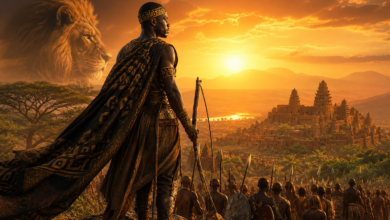
In the north of the continent, along the Nile, great civilizations emerged, including ancient Egypt and the kingdoms of Nubia and Kush, In the Ethiopian highlands, the Kingdom of Aksum became a major commercial and political power during the first centuries CE. In West Africa, political and trading centers flourished along trans-Saharan gold and salt routes, followed in different historical periods by the empires of Ghana, Mali, and Songhai. On the eastern coast, Swahili cities participated in the trading networks of the Indian Ocean, while the remains of Great Zimbabwe testify to the ability of African societies to build distinctive urban and political centers.
These civilizations were not copies of one another, nor did they develop along identical paths. Some relied on riverine agriculture, others benefited from long-distance commerce, while still others combined farming, animal husbandry, mining, and craftsmanship, Each society had its own circumstances, innovations, and challenges, This is the starting point for any serious study of African history: approaching each civilization as a human experience worthy of understanding, rather than as a contestant in a race to prove which society was the greatest.
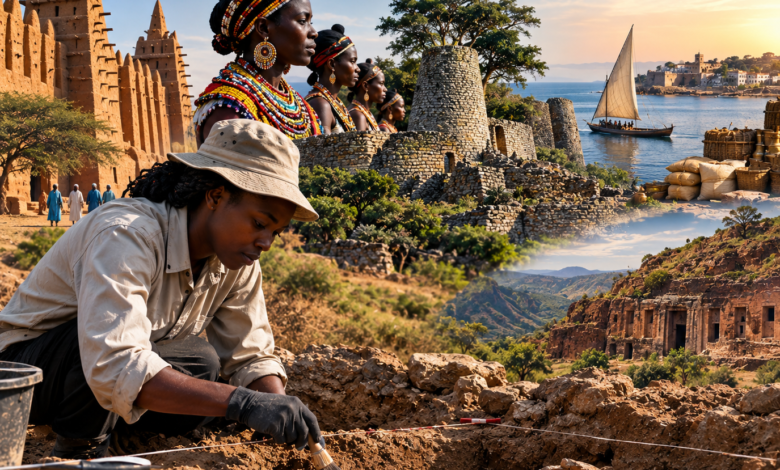
I sometimes imagine an archaeologist walking through an excavation site in West Africa at dawn, The sun has not yet grown fierce, and the air still carries the last traces of the night’s coolness, He bends over a small area marked out by his team and carefully removes the soil covering part of an ancient wall. Before him, there is no complete palace or treasure, only a layer of brickwork, traces of burning, and scattered pottery fragments. These objects might seem ordinary to someone passing by, but to the archaeologist they open the door to a series of important questions. How did people live here? What did they eat? Where did they obtain the materials used to make their tools? Did they trade with distant regions? And why did they eventually leave this place?
This imagined scene does not describe a specific excavation, but it captures the essence of archaeological work. We do not reconstruct the past simply by finding beautiful objects, We do so by connecting evidence, examining archaeological contexts, comparing discoveries, and testing possible interpretations, An undecorated pottery fragment may reveal more about everyday life than a magnificent gold object, It can help us understand food preparation, manufacturing, and exchange, while the gold object alone may tell us relatively little about the society that produced it.
For this reason, I believe that the greatest pleasure of archaeology lies not simply in discovering the past, but in recognizing how much we still do not know, Every reliable answer raises new questions, and every discovery may force us to reconsider assumptions we once accepted. What we know today is not the final word, It is the best explanation supported by the available evidence, subject to revision when new discoveries emerge.
This is also why I resist viewing African history through a single lens. We cannot reduce the continent’s achievements to one civilization, assume that every major development came from elsewhere, or attribute every ancient monument to a single origin without evidence, At the same time, African civilizations need neither exaggeration nor unsupported claims to establish their importance. When studied carefully, their actual histories are far more fascinating than the myths invented about them.
Egypt offers an important starting point for this exploration, but it is not the destination. The Nile Valley was a region of contact and exchange among different communities and kingdoms, Relations between Egypt and Nubia changed over time, encompassing trade and cultural interaction as well as political conflict and domination. Farther south, the Kingdom of Kush emerged, with Kerma, Napata, and Meroë serving as important centers during different periods. In the eighth century BCE, Kushite kings conquered Egypt and established the Twenty-fifth Dynasty. This was not a marginal episode in Egyptian or African history, but a fundamental chapter in the history of the entire region.
These developments remind us that modern political borders are not always useful for understanding the ancient world, People moved in search of water, pasture, raw materials, and commercial opportunities. Ideas traveled with merchants, craftspeople, soldiers, and religious figures, Ancient Africa was not a collection of isolated islands, but a diverse landscape of societies that sometimes interacted closely and sometimes developed along separate paths according to environmental, economic, and political circumstances.
In West Africa, trade routes tell a different story. Imagine a caravan crossing the Sahara during the age of the Mali Empire. Camels move slowly, their loads carefully arranged, while travelers watch the sky, conserve their water, and follow familiar tracks through the desert, Behind them lie cities and centers of production; ahead are markets awaiting goods from distant regions. The Sahara was not merely a barrier separating north from south, It was also a difficult passage that facilitated connections among different societies, Through the trade in gold, salt, and other commodities, cities such as Timbuktu and Djenné acquired considerable economic and cultural importance. Some West African centers also became places of learning, writing, and religious scholarship.
In Timbuktu, whose prominence grew particularly during the fifteenth and sixteenth centuries, life revolved around more than caravans and markets. Scholars taught, manuscripts circulated, and intellectual traditions developed that left an important legacy in West African history, This experience reminds us that knowledge has never belonged exclusively to a single continent, language, or political center, It has traveled along many routes, through different institutions, and across generations in a variety of forms.
Then there is Great Zimbabwe, where monumental stone walls testify to a society whose architectural skills and social and economic organization enabled it to establish a substantial urban center. These walls need no invented legend to make them extraordinary. Yet their history was distorted by prejudiced interpretations in the modern era, when some writers attempted to deny that local African communities could have built them. Archaeological evidence has established that the site was associated with local African societies and formed part of a wider economic world connected to regional and long-distance trade.
Here, the study of the past becomes a lesson for the present. How often do preconceived ideas prevent people from recognizing the evidence before their eyes?
Nevertheless, recovering African history should not become an inverted contest in which one prejudice is simply replaced by another. The goal is not to prove that one civilization was superior to all others, but to understand what different societies achieved, how they interacted with their environments, and what they passed on to later generations. Civilization is not a medal awarded to a single people. It is the result of multiple human experiences, each with its distinctive achievements and limitations.
As our knowledge of these societies expands, the meaning of the word forgotten begins to change. Some of these civilizations were never forgotten by the communities that inherited their memories, Their legacies survived in oral traditions, social practices, languages, and local histories, What sometimes happened was that global history books failed to give them the attention they deserved, their archaeological remains received insufficient study, or their stories reached international audiences through outsiders who did not always understand the societies they described.
We must therefore be careful even with the title of this series, Africa is not a continent without memory, It is a continent whose memory we have only partially come to understand.
This brings us back to the question with which we began: What remains of a human being after death?
Perhaps a wall, an inscription, a broken vessel, or a name preserved in a manuscript. Sometimes nothing recognizable survives. Yet the absence of archaeological evidence does not mean that life never existed, just as the discovery of an artifact does not give us the right to claim that we fully understand its owner, There is a considerable distance between what people experienced and what we can know about them, Research sometimes narrows that distance, while at other times it reminds us of the questions that remain unanswered.
Perhaps this is why Africa offers us something beyond the study of ancient history. It invites us to consider how societies choose what to remember and why some historical narratives become central while others remain on the margins, Every society inherits a past, but each generation reinterprets it according to the questions of its own time. When we open the pages of African civilizations, we do more than add unfamiliar names to our books. We reconsider the image of the world we have constructed for ourselves.
I do not want this journey to end with the kings of gold, the walls of stone, or the cities that flourished along commercial routes, I want us to reach the human being who once stood beside a river, crossed a desert, lit a fire at home, or made a vessel for a child, before disappearing from history and leaving behind a small trace of existence, Despite differences in language, time, and place, this person was not as distant from us as we might imagine. He or she faced questions of survival, belonging, fear, and hope—questions that remain part of the modern human experience.
The articles that follow will take us to different kingdoms, cities, and communities. We will examine each experience within its historical setting, drawing on archaeological excavations, written records, material remains, and the possibilities and limitations revealed by scientific comparison. We will not portray Africa as a mysterious puzzle, but as an essential part of human history, deserving to be studied with an open mind, a critical intellect, and a literary imagination that never betrays the truth.
Ancient civilizations are not merely stories about people who died long ago. They are mirrors in which we recognize something of ourselves, Through them, we learn that human beings are greater than the borders they draw and more complex than the images through which others attempt to define them.
Perhaps the greatest gift this journey can offer us is the realization that the world was never as small as we imagined, and that behind every history we know, there are other histories waiting to be heard.
read more