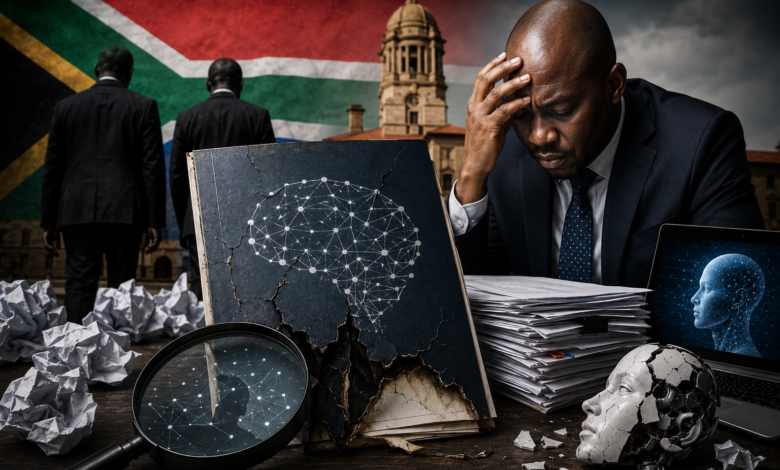
In a profound institutional embarrassment that has severely undermined South Africa’s ambitions to become the definitive technological hub of the African continent, the Department of Communications and Digital Technologies has been forced to abruptly withdraw its draft national artificial intelligence policy.
The structural collapse of the framework occurred after a local media exposé revealed that the governance document contained entirely fabricated academic references and non-existent journal citations—hallucinations deeply suspected to have been lazily generated by the very artificial intelligence tools the state was attempting to regulate.
This severe administrative oversight has forced Communications Minister Solly Malatsi to officially delay the implementation of the national AI policy until January 2027, plunging the nation into a prolonged regulatory vacuum at a moment of intensifying global digital competition.
The unravelling of the policy draft, which had already secured formal Cabinet approval and was undergoing public commentary, highlights a dark, ironic paradox within modern public administration, where sovereign authorities attempting to govern automated systems fall victim to the technology’s most insidious flaws, including weak verification protocols and systemic misinformation.
The institutional fallout has triggered a severe credibility crisis inside Pretoria’s civil service, resulting in the immediate precautionary suspension of two high-ranking officials and a public admission of failure before parliament by Minister Malatsi, who characterized the incident as a massive oversight compounded by an unauthorized, undisclosed reliance on generative software during the drafting process.
This policy paralysis leaves South Africa’s largest industrial economy completely devoid of a formal national AI governance framework, severely complicating urgent state efforts to regulate data protection, algorithmic bias, labor disruption, and AI-driven surveillance across its highly modernized banking, telecommunications, and cybersecurity sectors.
To aggressively salvage public confidence and rebuild the shattered framework from the ground up, Pretoria has appointed a seven-member independent review panel composed of leading academic minds, digital lawyers, and computer scientists.
Chaired by prominent AI research professor Benjamin Rosman and featuring leading experts such as Vukosi Marivate, Alison Gillwald, cybersecurity specialist Jabu Mtsweni, and cyber lawyer Lufuno Tshikalange, this elite panel is tasked with completely overhauling the corrupted text.
Ultimately, South Africa’s policy collapse delivers an absolute warning to sovereign states throughout the Global South: any attempt to accelerate technological regulation without cultivating deep technical expertise and absolute epistemic integrity within public institutions will inevitably collide with reality, transforming a bid for regional digital leadership into a cautionary tale of institutional vulnerability.
read more