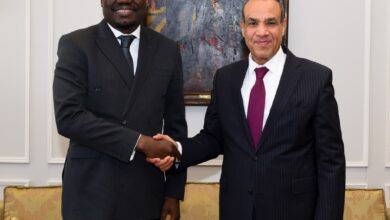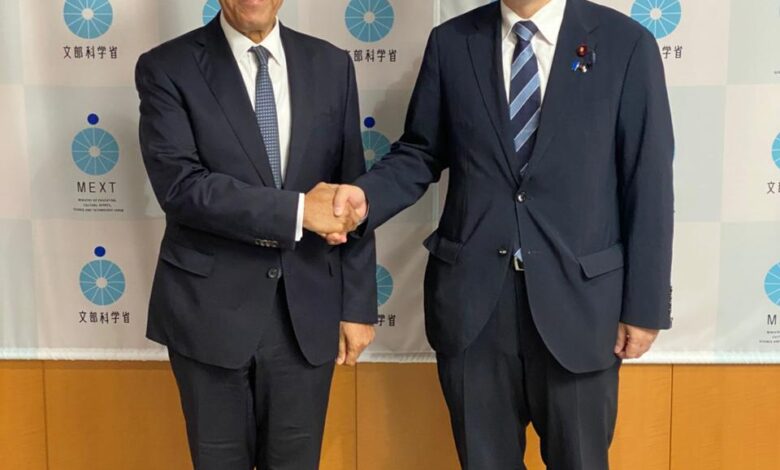
Egyptian Foreign Minister Badr Abdelatty and Japanese Education Minister Yuhei Matsumoto discussed on Thursday expanding cooperation in schools, technical education, higher education, and African capacity-building programs, with Egypt highlighting education as a key pillar of its strategic partnership with Japan, Egypt’s foreign ministry said.
FM Abdelatty, who is visiting Japan, praised the progress achieved under the Egyptian-Japanese Education Partnership (EJEP), launched in 2016, stating that it has made tangible contributions to the development of Egypt’s education system at various levels.
The foreign minister also welcomed Matsumoto’s visit to Egypt in January 2026, noting that it was the Japanese minister’s first overseas trip since taking office and reflected the importance Tokyo attaches to educational cooperation with Cairo.
Abdelatty said educational cooperation enjoys strong support from the leadership of both countries and remains one of the main pillars of the Egyptian-Japanese strategic partnership.
He expressed hope of building on the success of the Egyptian-Japanese Schools project by expanding the number of schools adopting the Japanese educational model in the years to come.
The minister also praised the establishment of the first Egyptian-Japanese Advanced Technical Education Institute in September 2025 and highlighted the role of the Egyptian-Japanese University of Science and Technology (E-JUST) in advancing scientific research and innovation.
He stressed the importance of continued cooperation in technical and technological education to prepare skilled graduates capable of meeting labour market demands and supporting Egypt’s economic development priorities.
The talks also addressed joint Egyptian-Japanese scholarships offered to African students within the framework of the Tokyo International Conference on African Development (TICAD), with Abdelatty expressing hope that E-JUST would host more African students to support human capital development initiatives across the continent.
He also affirmed Egypt’s readiness to cooperate with Japan to transfer Japanese educational expertise to African countries through trilateral cooperation mechanisms, drawing on Egypt’s experience implementing the Japanese education model.
Separately, Abdelatty met Akihiko Tanaka, president of the Japan International Cooperation Agency (JICA), to discuss strengthening development cooperation in priority sectors, including education, transportation, and private sector financing.
During the meeting, the foreign minister praised JICA’s support for educational projects in Egypt, underscoring the importance of enhancing E-JUST’s regional role by expanding partnerships with Arab and African universities and increasing training opportunities for African professionals.
The two sides also discussed expanding cooperation with Egypt’s National Anti-Corruption Academy through long-term institutional support programmes focusing on cybersecurity, combating organized crime, and strengthening governance.
In the transportation sector, Abdelatty expressed Egypt’s interest in deepening cooperation on the development of Cairo International Airport and Cairo Metro’s Line 4 to support growing tourism and improve transport infrastructure.
He also called for a greater role for JICA in supporting private sector investment in Egypt, particularly in small and medium-sized enterprises and renewable energy projects, in line with the country’s sustainable growth agenda.
The two sides agreed on the importance of maintaining close coordination and building on the achievements of recent years to further advance the Egyptian-Japanese partnership.
In recent years, education has become one of the defining pillars of Egypt-Japan relations since the launch of the EJEP in 2016, a flagship initiative that integrates key elements of Japan’s education model into Egypt’s school and higher education systems.
The partnership has led to the establishment of more than 50 Egyptian-Japanese schools nationwide, where students are taught using Japan’s tokkatsu educational philosophy, which emphasizes teamwork, discipline, responsibility, and character development alongside academic achievement.
A cornerstone of the partnership is the Egyptian-Japanese University of Science and Technology (E-JUST) in Borg El-Arab, Alexandria, established with Japanese support and now one of Egypt’s leading research universities.
The institution works closely with a consortium of Japanese universities.
It has become a regional hub for advanced scientific research, innovation, engineering, and postgraduate studies, attracting students from across Africa and the Middle East.
Educational cooperation has expanded further in recent years to include technical and vocational training. In September 2025, the two countries inaugurated the first Egyptian-Japanese Advanced Technical Education Institute, reflecting a shared focus on developing a skilled workforce to support Egypt’s industrialization agenda and meet labour market demands.
read more
Egypt, Italy FMs discuss de-escalating regional conflict, bilateral ties