In the profound mythological landscape of West Africa, particularly within the Akan tradition of Ghana, knowledge, wisdom, and the spoken word have never been viewed as free commodities floating in the ether, They are sacred currencies governed by cosmic order.
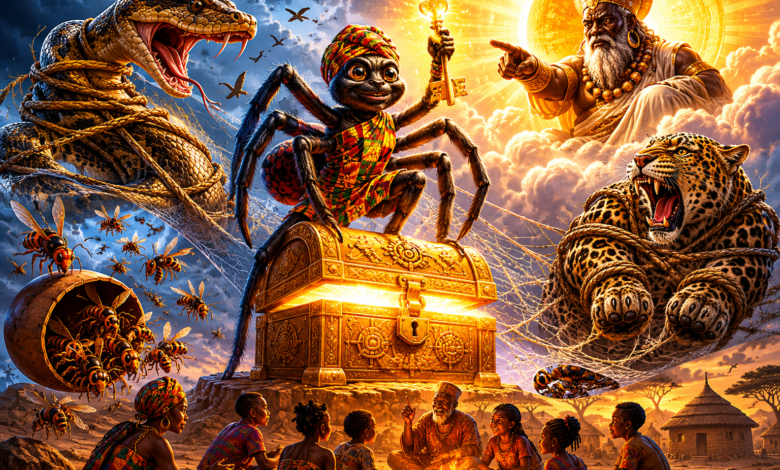
Long before the physical world became cluttered with human books and digital data, all stories, folklore, and historical memories belonged exclusively to Nyame, the omniscient Sky-God, who kept them locked in a golden chest suspended above the firmament.
This cultural reality reflects what Africanist scholars term an epistemological hierarchy, where divine monopoly precedes human enlightenment.
The protagonist of this structural realignment of knowledge is Kwaku Anansi, the legendary trickster spider. Anansi, possessing deep yearning and intellectual ambition, ascended to the heavens via a web of roaring lights to purchase the world’s tales.
Nyame, looking down with sovereign detachment, mocked the spider’s audacity and demanded an impossible currency for the golden chest: Onini the python, Osebo the leopard, and the Mboro hornets.
This divine transaction is not merely a fairy tale; as noted by the pioneering folklorist R.S. Rattray in his seminal fieldwork Akan-Ashanti Folk-Tales (1930, Oxford University Press), such narratives function as foundational myths explaining how human beings acquired the cognitive tools to interpret their environment and survive.
Anansi did not confront these lethal forces with raw muscle, for he understood that intellect is the ultimate weapon against chaos, To capture Onini the python, Anansi feigned a fierce domestic argument with his wife, loudly debating whether the great snake was truly longer than a specific palm branch. The python’s vanity became its veil of blindness.
Eager to prove its superior stature, Onini laid its massive body against the branch, allowing Anansi to bind it from head to tail with strong vines.
This specific motif of capturing the adversarial forces of nature through calculated linguistic manipulation is thoroughly dissected by literary scholar Kwesi Yankah in The Storytelling Journey of Anansi (1989, Indiana University Press), where the author demonstrates that in the Akan ethos, words possess a kinetic power capable of neutralizing physical dominance.
Using similar methodologies of intellectual urbanity, Anansi captured the Mboro hornets by pouring water over their nest and mimicking a torrential rainstorm, convincing them to fly directly into his dry gourd for protection.
Finally, he trapped Osebo the leopard by digging a deep pit along its hunting path, then offering his own web-string to haul the predator out, only to bind the leopard’s paws once it was suspended in mid-air.
Returning to the heavenly court, Anansi presented the three bound entities to the Sky-God. Nyame, astonished by the spider’s strategic resilience, declared before the heavenly assembly that the golden chest now belonged to Anansi, transforming the trickster into the eternal custodian of human narrative.
This ancient myth carries profound analytical weight. According to contemporary cultural anthropologist Mercy Amba Oduyoye in The Sons of the Gods and the Daughters of Men: An Afro-Asiatic Interpretation of Akan Myth (1984, Maryknoll), the Anansi cycle is not basic amusement but a sophisticated curriculum of survival.
It teaches that vulnerable populations can overcome systemic, structural disadvantages through fastidiousness of thought and epistemic humility. By distributing the stories to the ends of the earth, Anansi democratized the human mind, proving that light and knowledge, once locked away in sovereign isolation, must ultimately be shared to illuminate the collective path of humanity.
read more
Xenophobia Costs: Anti-Migrant Violence Bleeds South Africa’s Tourism Economy