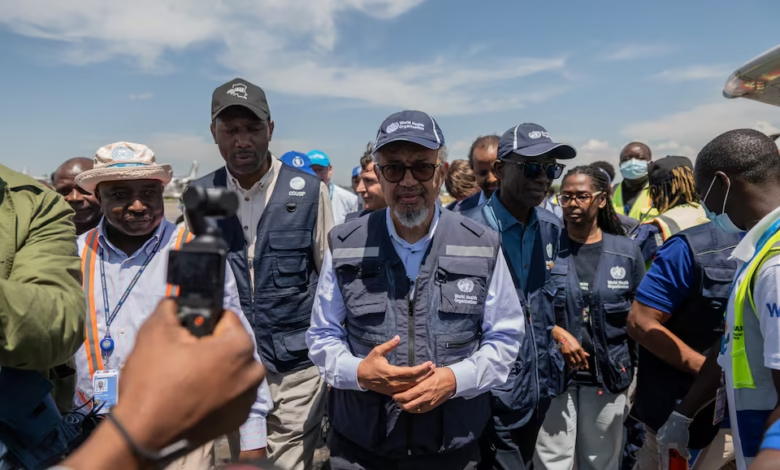
In an urgent geostrategic intervention from the epicenter of a rapidly escalating biosecurity crisis, World Health Organization Director-General Tedros Adhanom Ghebreyesus has fiercely condemned unilateral international travel bans and border closures, warning that reactionary isolationism will severely compromise the tracking of a deadly, vaccine-free strain of the Ebola virus.
Speaking from the capital of the northeastern Ituri Province alongside Congolese health authorities, the WHO chief stated that institutional containment relies entirely on community trust and uninhibited logistical corridors.
Aggressive border shutdowns by neighboring states do not halt transmission; instead, they paralyze international medical supply chains, drive high-risk migration underground, and actively discourage the sovereign transparency required to dismantle a transnational epidemic before it breaches wider sub-Saharan frontiers.
The current epidemiological emergency represents the 17th historical manifestation of the Ebola virus within the Democratic Republic of the Congo since its initial discovery in 1976, yet it presents a uniquely devastating clinical challenge.
Unlike more common variants, this outbreak is driven entirely by the Bundibugyo virus species, a highly lethal strain for which no licensed vaccine or targeted therapeutic treatment currently exists.
The speed of transmission has severely strained local public health networks; in a span of just two weeks, authorities documented over 1,000 suspected infections and more than 230 fatalities across three eastern provinces—Ituri, North Kivu, and South Kivu—while neighboring Uganda has already confirmed nine cross-border cases.
Because no preventative vaccine shield is available, clinical survival depends entirely on rapid detection and immediate supportive medical care, making unhindered localized access the single variable preventing a massive spike in mortality rates.
Despite the absence of a pharmaceutical cure, Congolese Health Minister Roger Kamba expressed firm institutional confidence, noting that the country’s extensive experience in successfully neutralizing sixteen previous outbreaks provides a reliable operational blueprint.
The government’s immediate strategic objective is to rigidly contain the geographic footprint of the virus within the three currently affected provinces, preventing a catastrophic structural spillover into dense urban hubs or broader regional trade networks.
To support this containment timeline, which authorities project will take four to six months, laboratory testing infrastructure has been aggressively optimized. Following severe initial delays, regional diagnostic units have processed roughly 900 biological samples, officially verifying 260 positive cases, with total testing velocity now scaling to an operational capacity of 200 to 300 diagnostic evaluations per day.
Ultimately, both the WHO and the Congolese Ministry of Health stressed that the primary line of defense against the Bundibugyo strain rests upon basic, non-pharmaceutical public health interventions.
These foundational measures include strict hand hygiene protocols, rigorous contact tracing, accelerated laboratory confirmation, and the implementation of safe, dignified burials—a highly sensitive cultural touchpoint, as touching the bodies of deceased victims remains a primary vector for viral transmission.
Addressing the compounding threats of rampant medical misinformation, disinformation, and growing institutional mistrust in a region already destabilized by protracted armed conflict, international health experts asserted that scientific, data-driven messaging must guide the global response, concluding that international solidarity, rather than border isolation, serves as the continent’s most resilient immunity.
read more