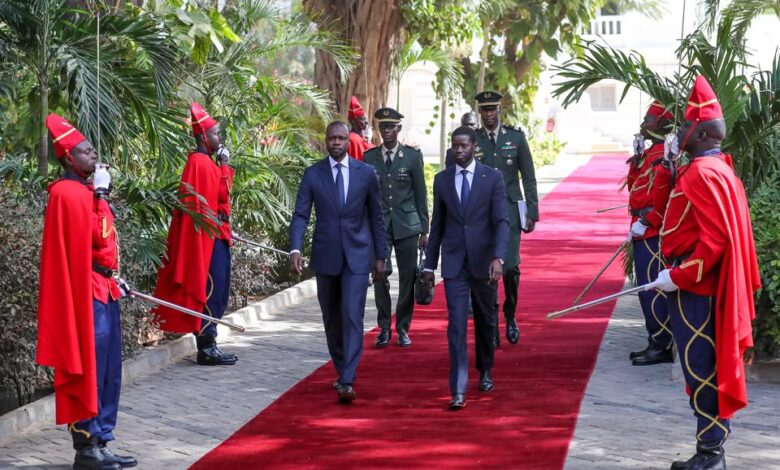
The fragile governing alliance that reshaped Senegalese politics has abruptly fractured, President Bassirou Diomaye Faye has issued an executive decree dismissing Prime Minister Ousmane Sonko and dissolving the entire cabinet, plunging the heavily indebted West African nation into acute political volatility.
Read on state television by presidential aide Oumar Samba Ba, the sudden purge permanently terminates the volatile diarchy that took power following the 2024 elections.
This institutional rupture exposes a deep-seated structural conflict between presidential authority and a highly popular, ideologically aggressive prime minister who served as the president’s original political mentor.
The spectacular collapse of the ruling Pastef party coalition is rooted in an intense rivalry over executive supremacy and the limits of state rhetoric.
While Faye owes his presidency to Sonko—who was legally barred from the 2024 ballot due to a defamation conviction—the political dynamic between the two leaders rapidly soured.
President Faye had openly criticized the excessive personalization of power within the executive branch, declaring that the head of government serves strictly at the pleasure of the presidency.
Conversely, Sonko had increasingly attacked Faye for an alleged failure of leadership, demanding unyielding executive backing against mounting legislative and public criticism of his highly confrontational administrative style.
This internal power struggle reached a critical tipping point following an aggressive ideological escalation by Sonko regarding international alignment and domestic legislation. Hours prior to his dismissal, Sonko delivered a fiery public address denouncing Western nations, specifically targeting France, for allegedly attempting to impose foreign social values on Senegal following the passage of a strict domestic law increasing criminal penalties for same-sex relations.
This radical pan-Africanist rhetoric directly subverted President Faye’s efforts to manage Senegal’s catastrophic macroeconomic crisis. Inheriting a staggering sovereign debt burden equivalent to 132 percent of gross domestic product, Senegal stands as the second-most indebted nation in sub-Saharan Africa, a reality that requires delicate, highly sensitive fiscal negotiations with Western financial syndicates and the International Monetary Fund.
By summarily firing Sonko, Faye has executed a high-stakes consolidation of constitutional power, gambling that the authority of the presidency can withstand the inevitable backlash from Sonko’s passionate, highly mobilized youth base. While hundreds of supporters gathered outside Sonko’s residence in Dakar’s Keur Gorgui neighborhood following the announcement, the ousted prime minister chose a calculated, non-violent response, publicly stating he would sleep soundly while looking ahead to future political contests.
Armed with recent electoral code amendments that restore his legal eligibility for the 2029 presidential cycle, Sonko’s removal does not signify his political liquidation; instead, it transitions him from a frustrated partner in governance to a formidable, unconstrained populist opposition leader operating against a debt-strangled state apparatus.
read more
Democracy for Sale, Dissent for Burial: The Political Economy of Repression Under Abiy Ahmed