Sacred Confluence: Socio-Economic Fabric and Transnational Solidarity of Eid al-Adha Across the Africa

Eid al-Adha, the Islamic Festival of Sacrifice, manifests across the African continent not merely as a profound spiritual milestone, but as a massive, synchronized macroeconomic catalyst and a vivid testament to transnational solidarity.
According to comprehensive developmental surveys conducted by the African Development Bank (AfDB), the annual observance galvanizes hundreds of millions of believers, weaving together ancient cultural heritage, deep spiritual devotion, and intense commercial activity.
In a continent where Islam plays an essential structural role in the societal fabric, reports from the Pew Research Center’s Religion & Public Life Project confirm that the ritual of the sacrifice transcends individual households, transforming into a sweeping collective manifestation of mutual aid, structural philanthropy, and continental unity.
At the absolute center of this annual transformation is the pastoral economy, which experiences a monumental surge in velocity weeks before the holiday.
Field assessments published by the Food and Agriculture Organization (FAO) indicate that in West Africa, particularly within the Sahelian corridors of Mali, Niger, and Burkina Faso, livestock traders orchestrate vast transnational networks to supply metropolitan hubs like Dakar and Abidjan.
This annual migration of livestock—most notably the highly prized Ladoum sheep in Senegal, which West Africa Agriculture Magazine documents as commanding staggering prices up to tens of thousands of dollars as symbols of prestige—represents a multi-billion-dollar trade network that sustains millions of rural herdsmen.
For these agrarian communities, macro-analyses from the Economic Community of West African States (ECOWAS) demonstrate that Eid al-Adha is the definitive fiscal anchor of the calendar, driving seasonal employment, transforming regional transport logistics, and infusing critical liquidity into rural economies that are otherwise isolated from formal banking systems.
Concurrently, the architectural framework of the holiday relies heavily on the Islamic concept of Takaful (mutual social responsibility).
The ritual slaughtering of the sacrificial livestock is strictly governed by institutionalized charity, wherein the meat must be meticulously partitioned into thirds: one for the immediate family, one for relatives and neighbors, and a final, non-negotiable portion reserved exclusively for the impoverished.
In regions currently navigating severe inflationary pressures or protracted internal displacements, seasonal situation reports from the United Nations World Food Programme (WFP) reveal that this systematic distribution functions as an essential, organic social safety net.
Furthermore, the African Union’s Department of Health, Humanitarian Affairs and Social Development notes that international humanitarian agencies and local civil society networks systematically leverage this period to execute large-scale, structured food security interventions, ensuring that the wealth generated by urban centers is directly redistributed to fragile peripheral communities.
Beyond its economic and humanitarian dimensions, Eid al-Adha in Africa is characterized by an extraordinary display of cultural urbanity and localized pageantry.
Ethnographic archives from the UNESCO World Heritage Centre highlight that in Northern Nigeria and across the Hausaland regions, the festival is heralded by the spectacular Hawan Daushe (The Durbar Festival), a magnificent cavalry parade orchestrated by traditional Emirs.
Cultural tourism ledgers from the Nigerian Tourism Development Corporation (NTDC) verify that this breathtaking display of equestrian skill, adorned in vivid, historic military attire, seamlessly fuses Islamic devotion with pre-colonial royal heritage, drawing global travelers and cementing domestic tourism.
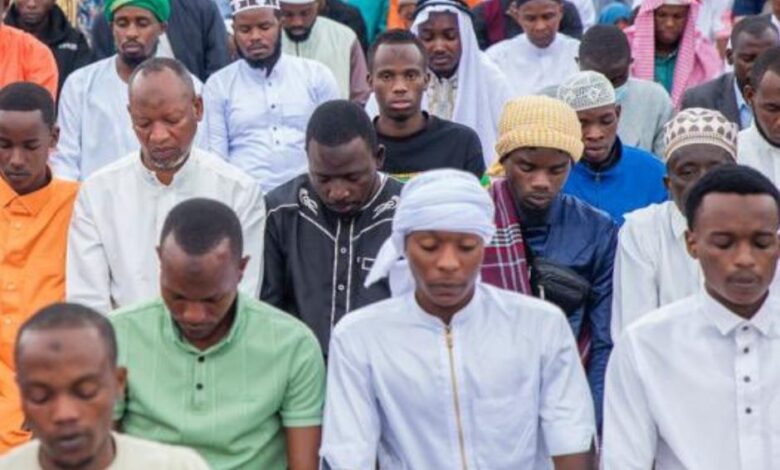
Similarly, documentation from the Egyptian Ministry of Tourism and Antiquities and Morocco’s Ministry of Awqaf and Islamic Affairs notes that the atmospheric essence of the holiday is defined by the communal Musalla prayers, where millions of citizens gather in massive open-air arenas at dawn, creating a powerful, uniform visual tapestry of spiritual egalitarianism before returning home to participate in the sacred family banquets.
Ultimately, research compiled by the Association of African Historians positions Eid al-Adha across Africa as a magnificent monument to civilizational resilience.
It demonstrates how a universal religious obligation can be masterfully localized to reflect the unique historical genius of diverse African societies while preserving its core theological integrity.
In an era defined by rapid modernization and complex geopolitical shifts, data from the African Union Commission proves that the festival remains an unyielding fortress of communal preservation, demonstrating that the ancient concepts of shared sacrifice, structural empathy, and familial devotion remain the absolute cornerstones of the continent’s enduring social peace.
read more
The Luminous Tapestry: Traditions of Eid al-Fitr (Lesser Biram) Across Non-Arab Africa